For properties with native forest in Acre, Amazonas, Mato Grosso, Pará and Rondônia (Brazil). A report prepared by Credita Carbon for your property: how many credits the forest could generate, how much they could earn per year, what could block the project and which path to take.

You provide the property's CAR code (Brazil's Rural Environmental Registry). Credita Carbon overlays the property with Verra's deforestation risk map, 10 years of satellite imagery and public land databases, runs the calculation under the current methodology and checks every step.
How much of the area is eligible forest and how many carbon credits it could generate per year.
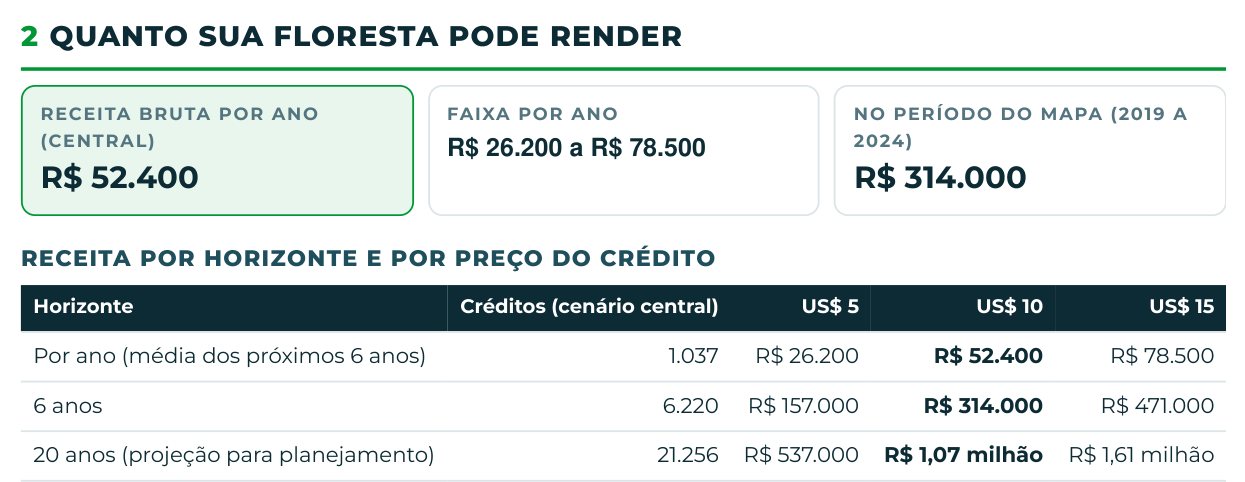
In the example: about 1,037 credits per yearEstimated gross revenue per year and over 6 and 20 years, at three market prices per credit.
In the example: R$ 26k to R$ 78k per yearOverlaps with Indigenous lands, protected areas, public forests, settlements and other CAR records, and what to regularize.
In the example: no overlapStandalone project, grouped project or other revenue for the forest, with reference costs and next steps.
In the example: grouped projectKey parts of a diagnostic for an area in Mato Grosso, with the CAR code and municipality hidden. The full report has about 18 pages and is written in Portuguese.
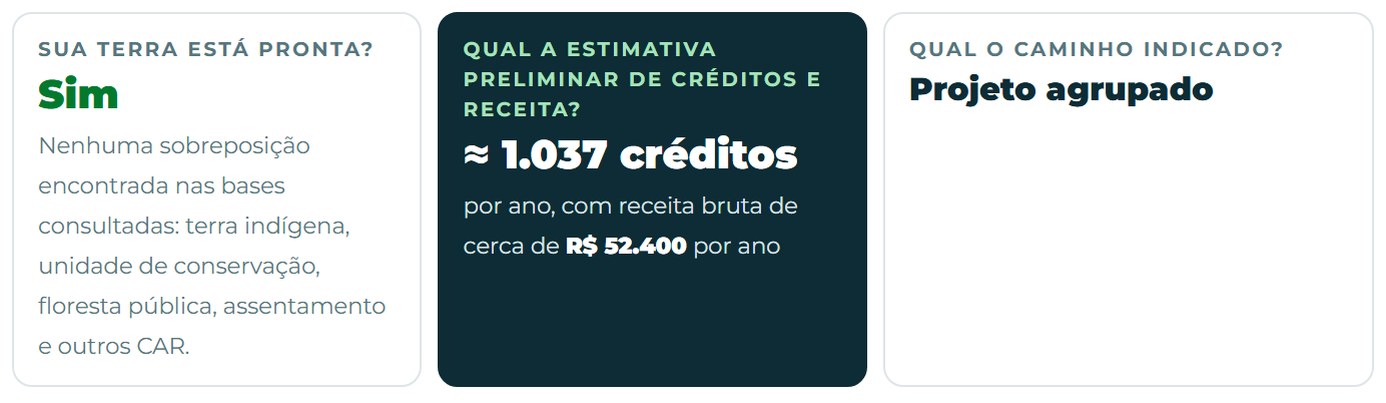
On the report's first page: whether the land is ready, the estimated revenue and the recommended path, in plain language. The details follow on the next pages.

Revenue per year, over 6 years and over 20 years, with credits at US$ 5, 10 and 15. Then the cost of a standalone project and whether it pays for itself.
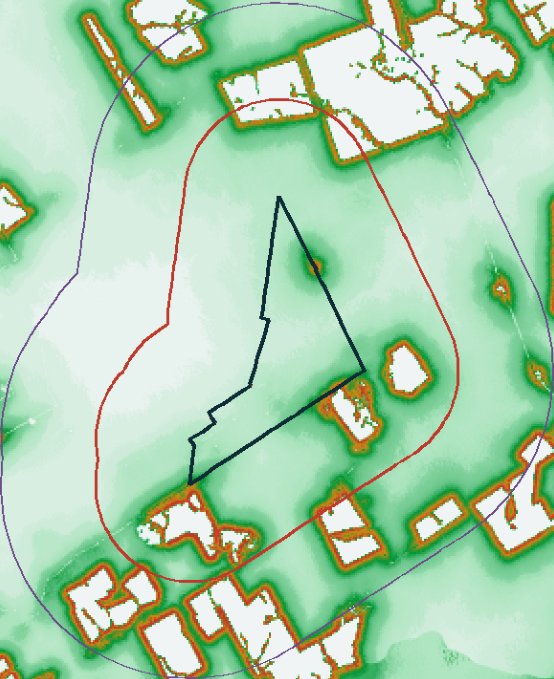
The deforestation Verra projects for the property's region. The credit volume comes from it, which is why the figure belongs to your area and is not an average per hectare.
Forest carbon projects are monitored for decades. Signing up without knowing the area's potential means deciding in the dark.
In the Brazilian projects analyzed, Verra's current rules cut credits by about 40% on average. Older estimates may be inflated.
Under Verra's rules, only area where the owner proves their rights generates credits. Overlaps with third-party land are excluded.
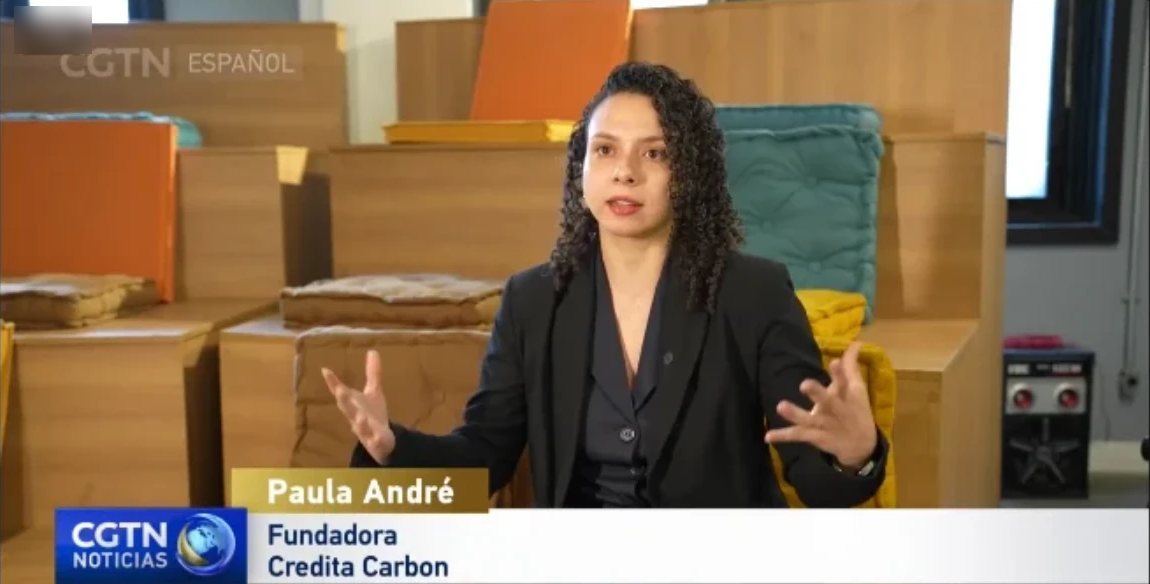

Here, the people who sell are the people who calculate. Every diagnostic is prepared directly by Credita Carbon, drawing on the experience of its founder, Paula André, to check the calculation, the land check and the recommended path before the report reaches you.
A chemical and bioprocess engineer from UFRJ, Paula specializes in carbon markets and decarbonization and speaks on the topic in Brazil and abroad. Credita Carbon created the diagnostic so that forest owners can decide with figures for their own property, not averages per hectare.
Pix or up to 12 installments by card. Your access link arrives by email right after.
In your client area, type the property's CAR code. Not sure where to find it? The team helps on WhatsApp.
Within 7 days, by email and on the website.
A full feasibility study usually costs between USD 3,000 and USD 6,000. Here you start with a preliminary assessment of your area, before the big expenses.
No. You buy first and enter the CAR code later, in your client area. It is on the CAR registration receipt. If you cannot find it, the team will guide you on WhatsApp.
Properties with native forest in Acre, Amazonas, Mato Grosso, Pará and Rondônia, with an active, pending or suspended CAR record (not cancelled). If you buy for a property outside these rules, you can cancel within 7 days of purchase for a full refund.
No. The diagnostic is a screening: it shows whether there are favorable signs and what needs to be resolved. Actual feasibility depends on a forest inventory, proof of land rights, the project design and approval by the certification standard. The number of credits is also an estimate: the final figure only comes with the forest inventory and project validation.
Yes. The CAR code is already public and is used only to prepare the diagnostic of your area. Your details are not sold or shared, except with the payment processor, and you can ask for them to be deleted at any time.
No. The report is yours, with no exclusivity. You decide whether, when and with whom to move forward.
The report shows what was found, such as overlaps with Indigenous lands, protected areas, public forests or settlements, and what needs to be regularized before a project. If the CAR record is cancelled, you can switch to another property or withdraw within 7 days of purchase, with a full refund.
The report says so clearly and shows other revenue paths for the area, when there are any. Knowing this early avoids larger spending on inventory, documentation and certification.
No. Before signing any carbon contract, we recommend having a lawyer you trust read it. You can take the report to them.
The access link arrives by email as soon as payment is confirmed (a few minutes with Pix). Once you enter the CAR code, Credita Carbon prepares the diagnostic and the full report reaches your email within 7 days. After that, it is also available on the website.
Required: only the CAR code. It is on the CAR registration receipt and contains the state abbreviation, 7 municipality digits and 32 letters and numbers (for example: PA-1500000-1A2B...). You enter it after purchase, in your client area.
Optional, for a more accurate result (uploaded in your client area before the diagnostic starts):
Other formats, such as standalone .shp, .dwg, spreadsheets or photos, are not read by the system. If that is all you have, send just the CAR code or contact the team on WhatsApp.
Yes. Each diagnostic covers one property, meaning one CAR code. If you buy more than once with the same email, all of them stay in the same client area.
The CAR (Rural Environmental Registry) is self-declared: the owner or holder reports the property's boundaries and vegetation. It does not prove ownership, possession or the actual boundaries. That is why the diagnostic is a preliminary assessment, and a project must verify the land documents.
No. The checkout, the client area and the report are in Portuguese. The figures, maps and tables are easy to follow, and the team can answer questions on WhatsApp.
The advantage of a preliminary assessment is getting there before the big expenses. For a fraction of the cost of a full study, you find out whether it is worth investing in a forest inventory, documentation and certification, compare proposals with figures for your own area and negotiate knowing what you have. Because the diagnostic starts from the CAR, a self-declared registry that does not prove ownership, possession or the property's actual boundaries, the result is a preliminary estimate and does not establish the actual feasibility of a carbon project. That confirmation only comes with a full study, a forest inventory, a documentary review of the land and validation by a certification standard.
Purchase in 2 minutes. You enter the CAR code later.
Get my diagnostic